
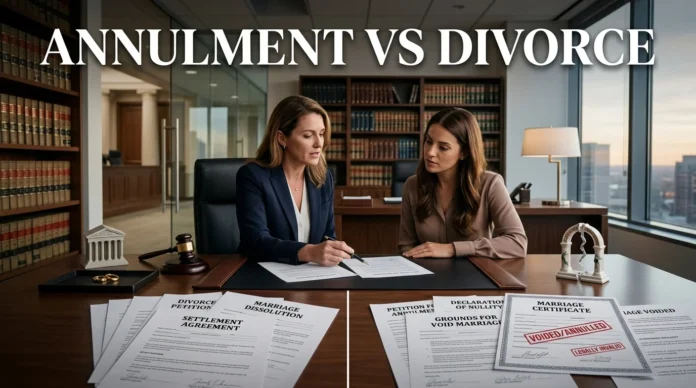
Ending a marriage can involve different legal routes, and their names can make them sound more interchangeable than they are. The core annulment vs divorce question is whether the marriage was legally valid in the first place. Also worth reading: Speeding Ticket.
Short answer: A divorce ends a marriage that the law recognizes as valid. A civil annulment asks a court to declare that the marriage was invalid or voidable from the start. For most U.S. couples, divorce is the practical route. Annulment is available only when state law provides a qualifying ground.
| Question | Civil annulment | Divorce |
| Legal effect | Challenges the marriage’s validity | Ends a valid marriage |
| Eligibility | Requires a recognized legal ground | Based on the state’s divorce grounds |
| Proof | Evidence of the invalidating condition is usually required | A no-fault ground may be available |
| Property and support | Treatment depends on state law and the facts | Courts can divide property and address support |
| Children | Parenting and support issues still require resolution | Custody and support can be resolved in the case |
| Religious effect | Civil and religious rulings are separate | Civil divorce does not itself determine religious status |
State law controls each of these issues. Grounds, deadlines, procedures, and financial consequences can differ significantly from one jurisdiction to another.
Annulment vs Divorce: The Legal Difference That Controls the Case
A divorce accepts that a legal marriage existed and brings it to an end. An annulment case challenges whether a valid marriage was created at all.
That distinction matters because dissatisfaction with a marriage is not, by itself, a reason for annulment. A person generally must show that a legal defect existed when the marriage began. Such grounds may include bigamy, incapacity, force or duress, and certain types of fraud.
Divorce works differently. A court can end a recognized marriage and resolve related questions involving finances, property, support, and children.
When Can a Court Declare a Marriage Invalid?
The exact grounds are determined by state law, so there is no universal U.S. checklist. Still, commonly recognized issues may include:
- One spouse was already legally married to someone else.
- A spouse lacked the legal or mental capacity to consent.
- Force, threats, or duress caused someone to marry.
- A person was below the lawful age under applicable rules.
- The spouses were within a prohibited degree of relationship.
- Fraud affected consent to the marriage.
A person seeking an annulment generally must prove a legal reason that the marriage was invalid from the beginning. Agreement between the spouses alone does not establish such a ground.
Fraud can be especially misunderstood. Not every lie between spouses makes a marriage legally invalid. In jurisdictions that recognize fraud as a ground, the deception may need to be material to marital consent or affect an essential aspect of the marriage.
This is why a short marriage does not automatically qualify for annulment. Its length may affect the practical circumstances, but legal eligibility depends on the governing law and the specific ground being claimed.
When Divorce Is Usually the Better Fit
Divorce is usually the relevant path when the marriage was valid, but the relationship later broke down. A court can address far more than marital status. Depending on local law, the case may cover property, debts, parenting arrangements, child support, and spousal maintenance.
The process may also be contested or uncontested. When spouses agree on financial and parenting matters, an uncontested case can involve fewer disputes. When they disagree, additional hearings and legal work may be required.
The key point is that annulment is not a substitute someone can choose simply because they would prefer not to get divorced. Eligibility comes before preference.
What Happens to Property, Support, and Children?

Financial consequences deserve special attention because simple online definitions can create the wrong impression. Do not assume that declaring a marriage invalid automatically makes every financial issue disappear. Courts may still need to determine ownership, debts, support, or other claims. The available remedies depend on the jurisdiction and the facts of the case.
A standard divorce has a clearer framework for resolving marital finances. Depending on state law, spouses may need to provide financial disclosures, and courts may apply specific rules when dividing marital property or determining support.
Children do not lose their legal relationships with their parents when their parents’ marital status changes. Custody, parenting time, parentage, and support may still require court orders. Family law procedures vary by state, so parents should check local rules rather than assume that a marital-status ruling settles everything.
Is One Route Faster or Cheaper?
There is no dependable rule stating that an annulment is faster or cheaper. A case challenging marital validity may require evidence and testimony regarding the events surrounding the wedding or the parties’ consent. A disputed divorce can also become lengthy when spouses disagree over property, support, or parenting.
Legal costs therefore depend more on filing rules, attorney involvement, evidence, disputes, and court schedules than on the name of the proceeding.
Timing rules deserve equal attention. Some states impose deadlines tied to particular grounds. A person considering annulment should check the law in the state where the case will be filed rather than assume that a recent or brief marriage guarantees eligibility.
Civil and Religious Annulments Are Not the Same
A religious declaration of nullity and a civil court order operate under different systems. A religious annulment concerns the rules of a particular faith. It does not replace the civil legal process required to change a person’s marital status under state law.
Likewise, an ecclesiastical ruling may concern the validity of a marital bond under religious law without having a civil effect on matters such as custody, support, or property. Someone with both legal and religious concerns may therefore need to address each process separately.
READ MORE: 4 Ways Social Security Disability Claim Lawyers Maximize Your Chances of Approval
Pros and Cons of Each Option
Civil Annulment
Pros
- Accurately addresses a marriage that was legally defective from its formation.
- Can restore unmarried legal status when the required ground is proven.
- Focuses on problems that existed when consent was given or the marriage was created.
Cons
- Grounds are narrow and vary by jurisdiction.
- The person filing may carry a significant burden of proof.
- Deadlines can apply to certain claims.
- Property and support consequences may require separate legal analysis.
Divorce
Pros
- Is designed to end a valid marriage that has broken down.
- Can address financial and parenting issues in the same court proceeding.
- May offer uncontested procedures when spouses have resolved their disputes.
Cons
- Contested cases can require repeated court appearances.
- Property, support, and parenting disputes can increase costs and extend the process.
- The decree ends a valid marriage rather than declaring it invalid.
Which One Should You Choose?
The better question is not which procedure sounds preferable. Instead, ask which legal procedure your circumstances support.
If your marriage was valid and the relationship later failed, divorce is generally the appropriate route. If a serious legal defect existed when you married, a family-law attorney can assess whether your state’s annulment rules may apply.
Before filing, gather the facts that matter:
- Identify the claimed problem and determine when it existed.
- Collect records, messages, certificates, or other relevant evidence.
- List property, debts, children, and support issues that may require court orders.
- Check your state’s legal grounds and filing deadlines.
- Consider seeking legal advice when the case involves disputed validity, fraud, coercion, significant assets, or children.
For more general legal coverage, readers can also explore NewPape’s Law section.
The Bottom Line
Annulment and divorce can both change marital status, but they address different legal problems. One challenges whether a valid marriage was formed. The other ends a marriage recognized as valid by the law.
If you are unsure which route applies, start with the law in the state where you expect to file. When a case involves disputed validity, fraud, coercion, substantial property, or children, consider speaking with a qualified family-law attorney before relying on general online information.
Frequently Asked Questions
Divorce is often more straightforward when the marriage was legally valid. An annulment claim requires a recognized legal ground and proof that the ground applies. The exact burden and procedure depend on state law.
Possibly, but the length of the marriage alone does not answer the question. Eligibility and filing deadlines depend on the state and the legal ground involved. Do not rely on the common assumption that annulment is available only during the first few months of marriage.
Parents can still have custody, parenting, parentage, and support obligations. A court may need to resolve those matters under applicable family-law rules.
No. A religious tribunal applies the rules of its faith, while a civil court determines legal marital status. A religious declaration does not replace the required civil proceeding.
A final civil judgment can return the parties to unmarried legal status, subject to local rules and any applicable waiting period. Religious rules for remarriage are separate and should be checked with the relevant faith community.