

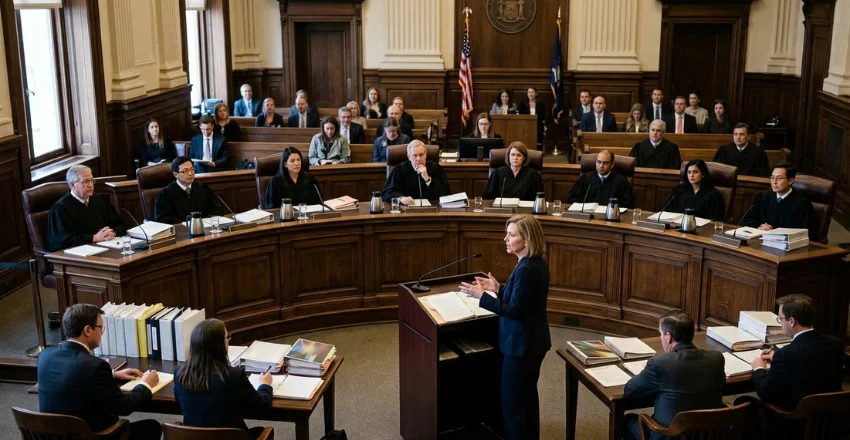
The en banc meaning is simple: a larger group of appellate judges hears a case together. Most federal appeals are decided by three-judge panels. Full-court review is reserved for unusual cases involving important legal questions or conflicts in precedent.
Quick answer: En banc is French for “on the bench” or “as a full bench.” In U.S. appellate practice, it describes review by the court’s active judges together, rather than the usual three-judge panel. Some large courts use a smaller authorized full-court panel instead.
Key Facts at a Glance
| Question | Answer |
|---|---|
| What does the term mean? | A larger or full bench of appellate judges considers a case together. |
| Where is it commonly used? | Federal and state appellate courts. |
| What happens normally? | Federal appeals courts usually decide cases through three-judge panels. |
| Why is full-court review used? | Often to maintain consistent precedent or address exceptionally important questions. |
| Is review automatic? | No. Federal rules describe this form of rehearing as disfavored and exceptional. |
| Does every active judge always participate? | Not necessarily. Court structure, recusals, and special rules can affect membership. |
| Which federal rule now covers rehearing? | Federal Rule of Appellate Procedure 40. |
What Does En Banc Mean in Law?
The phrase comes from French and roughly means “on the bench” or “as a full bench.” It describes judges considering an appellate matter together. The process differs from the smaller panels used for ordinary appeals.
Federal circuit courts generally decide appeals using panels of three judges. In limited circumstances, a larger group can reconsider a panel decision. The Federal Judicial Center says most such proceedings reconsider cases panels have already decided.
The Ninth Circuit illustrates an important exception to the simple “every judge” definition. Its full-court procedure normally uses an 11-judge panel. That structure means the phrase does not always describe every active judge physically participating.
Why Would an Appeals Court Hear a Case This Way?
Federal appellate rules treat full-court rehearing as an exceptional procedure. The process can help maintain consistency among a circuit’s decisions. It can also address questions carrying exceptional legal importance.
Imagine a three-judge panel issues a decision that conflicts with earlier circuit precedent. Leaving both decisions in place could create uncertainty for lower courts. Broader review gives the circuit an opportunity to resolve that conflict.
A significant legal question can provide another reason for review. The issue might affect many future cases beyond the immediate dispute. Still, importance alone does not guarantee that judges will agree to rehear the matter. Legal terms often carry narrow meanings, much like the way U.S. theft laws define grand larceny by specific thresholds.
How En Banc Review Usually Works
An appeal normally reaches a federal circuit court after proceedings in a lower federal court. A three-judge panel reviews the relevant issues and issues its decision. The losing party may then consider available options for further review.
A party can petition for panel rehearing or rehearing by the broader court. Judges can also consider broader rehearing without a party initiating the process. A majority of eligible active circuit judges must support rehearing when the court votes.
Granting review is uncommon, not routine. The Federal Circuit expressly describes this procedure as rare. It generally expects parties to identify conflicts with controlling precedent or another recognized basis for full-court consideration.
En Banc Meaning Versus a Regular Panel Hearing
The en banc meaning becomes clearer when compared with an ordinary appellate panel. Both procedures involve appellate judges reviewing legal issues. The main differences involve participation, frequency, and institutional purpose.
| Feature | Regular Panel | Full-Court Review |
|---|---|---|
| Typical federal membership | Three judges | Larger group of active circuit judges |
| Frequency | Normal appellate procedure | Uncommon |
| Main role | Decide an individual appeal | Address qualifying issues requiring broader consideration |
| Precedent concerns | Applies existing circuit law | May resolve conflicts within circuit precedent |
| Exceptional importance | Not required | Can support broader review |
| Ninth Circuit | Three judges normally | Usually an 11-judge panel |
The broader procedure should not be understood as another trial. Appellate courts generally review legal issues and the existing record. They do not ordinarily repeat the original trial or hear the case from scratch.
The larger bench also does not automatically imply a particular outcome. Judges can affirm, reverse, or otherwise change the earlier result. What matters is that the court has chosen broader institutional review.
What Happens to the Earlier Panel Decision?
The effect of granting rehearing can depend on the court’s governing rules. For example, the Fourth Circuit states that granting rehearing vacates the previous panel judgment and opinion. The case then proceeds before the broader court.
That distinction matters when reading court news. A panel may have announced an important ruling months earlier. Later full-court review can change the procedural status and eventually produce a superseding decision.
Readers should therefore check whether a reported opinion remains controlling. News articles sometimes continue circulating after a procedural change. The court’s docket and current orders provide the strongest status information.
Rule 35 or Rule 40? An Important Current Update
Older articles often connect this procedure with Federal Rule of Appellate Procedure 35. That reference was historically correct. A 2024 amendment transferred Rule 35’s contents into Rule 40.
Current Rule 40 addresses panel rehearing and broader appellate rehearing together. The consolidation reduced overlapping provisions between the former rules. This update matters when researching current federal appellate procedure.
Older court opinions can still refer to Rule 35 because that numbering applied at the time. Those references are not necessarily errors. For current federal filings, readers should consult the latest rules and applicable circuit requirements.
Does Full-Court Review Mean the Supreme Court Is Involved?
No. This procedure happens within an appellate court and does not mean the Supreme Court has accepted the case. The circuit court is reconsidering the matter using its own broader judicial membership.
A case may later reach the Supreme Court through a petition for a writ of certiorari. A rehearing petition is not always required before seeking Supreme Court review. The Federal Circuit expressly states that litigants need not request rehearing first.
These processes therefore serve different functions. Full-court rehearing asks an appellate circuit to reconsider a matter internally. Certiorari asks the Supreme Court to consider reviewing the lower court’s judgment.
Does En Banc Mean Every Judge Participates?
Not always. The basic definition refers to the full bench, but federal law and circuit procedures create qualifications. Recusals, disqualifications, senior status, vacancies, and circuit-specific practices can affect participation.
The Ninth Circuit provides the clearest example for U.S. readers. Its glossary explains that its broader panel includes 11 judges rather than every active judge. The national federal courts glossary also notes that larger courts can use divided full-court panels.
That is why “all judges” works as a basic definition but needs context. Check a specific case against that court’s rules. The order granting review may also identify participating judges.
A Simple Example
Suppose a three-judge federal appellate panel decides how to interpret a federal statute. Lawyers argue that the decision conflicts with an earlier ruling from the same circuit. That conflict could leave lower courts uncertain about which precedent controls.
The broader court then agrees to rehear the case. Eligible judges reconsider the disputed legal issue together. Their later decision can establish the circuit’s controlling approach to that question.
This example explains why the process matters beyond one lawsuit. Consistent circuit precedent helps lower courts apply the same legal rule. It also gives lawyers clearer guidance when handling similar future cases.
Why the Term Appears in Major Legal News
Broader appellate review often appears in reporting about consequential court disputes. That does not mean every widely reported case receives it. Courts still apply procedural standards before granting review.
Readers who want another plain-language explainer on federal law can read about how federal obstruction laws work.
The Federal Judicial Center identifies consistency, correction of panel error, and important legal issues among historical reasons for broader review. It also emphasizes that such proceedings represent only a small percentage of appellate cases.
Readers should focus on the procedural meaning rather than assuming a result. Granting review says the court will reconsider the matter differently. It does not tell you how the judges will ultimately rule.
Frequently Asked Questions
What is the en banc meaning in simple terms?
En banc means an appellate case is heard by a broader bench instead of the normal smaller panel. In federal appeals, ordinary cases usually go before three judges. Full-court proceedings are comparatively uncommon.
Is an en banc hearing the same as an appeal?
Not exactly. An appeal asks a higher court to review a lower court’s decision. Broader rehearing usually occurs within the same appellate court after, or sometimes instead of, ordinary panel consideration.
Who can request broader rehearing?
A party to an appellate case may file an appropriate rehearing petition under applicable rules. The court can also initiate consideration on its own. Circuit-specific procedures and deadlines still apply.
Why would judges grant rehearing?
Federal rules identify conflicts affecting uniformity and questions of exceptional importance as central grounds. Courts treat the procedure as extraordinary rather than routine. A simple disagreement with an unfavorable result may not be enough.
Does the Supreme Court sit en banc?
The expression mainly matters when discussing appellate courts that normally use smaller panels. The Supreme Court already hears cases as a multi-justice court under its own procedures. Federal circuit rehearing rules therefore address a different institutional structure.
Is “in banc” the same thing?
Yes, the federal judiciary notes that “in banc” is an occasional alternative spelling. “En banc” is the form readers will usually encounter today. Both refer to full-bench consideration in this context.
The Bottom Line
Full-court review is an unusual appellate procedure used for selected cases. It brings a broader group of judges into a matter normally handled by a smaller panel. The procedure can resolve conflicting precedent and address exceptionally important legal questions.
For U.S. federal practice, remember one current detail. The relevant rehearing provisions now appear in Federal Rule of Appellate Procedure 40. Older references to Rule 35 may reflect the rules before the 2024 consolidation.
When you encounter the phrase in a headline, check the court’s actual order next. That document shows what review was granted and which rules apply. It gives better procedural context than the headline alone