
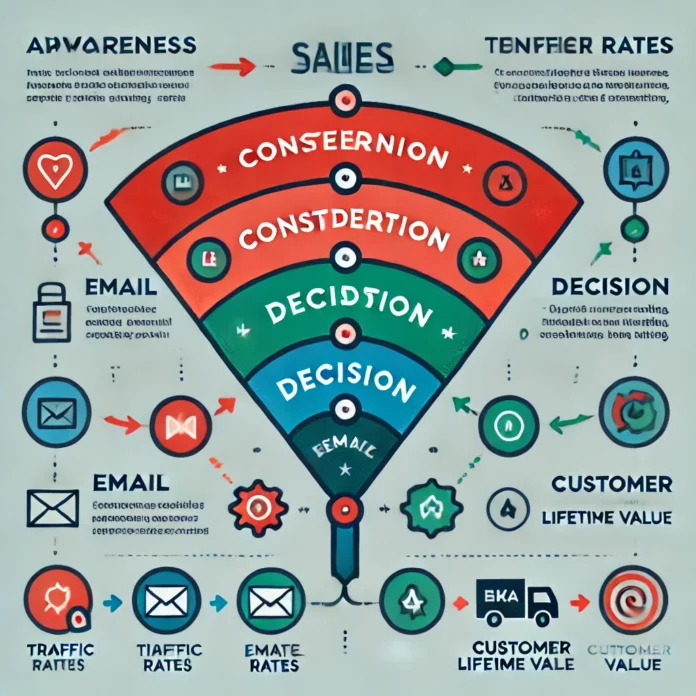
The funnel metrics that matter most for lead generation and sales are the ones that show where prospects move forward and where they stall: visitor-to-lead rate, lead-to-opportunity rate, opportunity win rate, sales cycle length, cost per lead, customer acquisition cost and customer lifetime value. Track them stage by stage, compare each stage with the one before it, and you will know exactly which part of the funnel to fix first. This guide explains what each metric measures, how to calculate it, and what to do when the number looks wrong.
Why funnel metrics matter more than total leads
A raw lead count tells you very little. Two hundred leads that never reach a sales conversation are worth less than forty that turn into pipeline. Well-chosen funnel metrics break the journey into stages, so you can see conversion between each step rather than a single blended result. That stage view does four useful things:
- It locates the leak. If traffic is healthy but few visitors convert to leads, the problem is your offer or landing page, not your ads.
- It aligns marketing and sales. Shared definitions of a marketing qualified lead (MQL) and sales qualified lead (SQL) end the “the leads are bad” versus “sales doesn’t follow up” argument.
- It connects activity to goals. Funnel numbers translate neatly into team OKRs, for example “raise SQL-to-opportunity conversion from 30% to 40% this quarter.”
- It guides budget. Cost and conversion data by channel show where an extra dollar is most likely to produce a customer.
Define your funnel stages first
Metrics only work if everyone uses the same stage definitions. A typical B2B funnel looks like this, though you should adapt the names to your own process:
| Stage | What qualifies a contact | Key conversion to watch |
|---|---|---|
| Visitor | Anyone who lands on your site or content | Visitor-to-lead rate |
| Lead | Shared contact details (form, demo request, download) | Lead-to-MQL rate |
| MQL | Meets fit and engagement criteria set by marketing | MQL-to-SQL rate |
| SQL | Accepted by sales after a qualifying conversation | SQL-to-opportunity rate |
| Opportunity | Active deal with a defined need, budget and timeline | Win rate |
| Customer | Signed contract or completed purchase | Retention and expansion |
Write the entry criteria for each stage down and store them in your CRM. If a rep can move a deal to “opportunity” without a budget conversation, your win rate will be meaningless.
Top-of-funnel metrics: awareness and engagement
Traffic by source
Break sessions down by channel: organic search, paid search, paid social, organic social, email, referral and direct. Volume alone is not the goal. Pair each source with its downstream conversion so you can spot channels that bring plenty of visits but few qualified leads. Organic search often converts well because the visitor arrives with a stated need; our guide on how SEO services contribute to better conversion rates covers that relationship in more depth.
Visitor-to-lead conversion rate
Formula: new leads ÷ unique visitors × 100. This is the clearest test of whether your offers, forms and landing pages work. Measure it per landing page and per channel, not just site-wide, because a strong blog can mask a weak pricing page.
Content engagement
In Google Analytics 4, the old bounce rate has been reframed around engaged sessions (a session lasting longer than 10 seconds, with a key event (formerly called a conversion), or with two or more page views) and engagement rate. Use engaged sessions, average engagement time and scroll depth to judge whether content holds attention. Treat these as diagnostic signals rather than goals in themselves: a page that answers a question quickly can have short engagement and still do its job.
Mid-funnel metrics: nurturing and qualifying leads
Lead-to-MQL and MQL-to-SQL rates
These two ratios show whether marketing is generating the right people, not just more people. A low lead-to-MQL rate usually means targeting or offers attract poor-fit contacts. A low MQL-to-SQL rate often means the MQL threshold is too loose, or that sales is not following up quickly enough. Check both together before deciding which team needs to change.
Speed to lead
Measure the time between a lead raising their hand (demo request, contact form, trial signup) and the first meaningful human response. Interest fades quickly, and slow follow-up is one of the most common and fixable reasons inbound leads go cold. Report the median, not the average, so a handful of weekend submissions does not distort the picture.
Email engagement
Click-through rate and click-to-open rate are more reliable than open rate. Since Apple Mail Privacy Protection launched in 2021, many opens are recorded automatically whether or not a person read the email, which inflates open rates. Judge nurture sequences on clicks, replies and the share of recipients who move to the next funnel stage.
Lead scoring accuracy
If you score leads, test the model. Compare the scores of leads that became customers against those that did not. If high scorers close at roughly the same rate as low scorers, the scoring criteria are not predictive and should be rebuilt around the attributes and behaviors your actual buyers share.
Bottom-of-funnel metrics: conversions and revenue
Opportunity win rate
Formula: deals won ÷ (deals won + deals lost) × 100 for a given period. Exclude open deals, or the number will drift with timing. Segment win rate by lead source, deal size and rep to find where the process works best.
Sales cycle length
The average or median number of days from opportunity creation (or first touch) to close. A lengthening cycle can signal new decision makers, budget pressure or a pricing problem. It also matters for forecasting: if your cycle is 90 days, this quarter’s revenue largely depends on last quarter’s pipeline.
Quote-to-close ratio and average deal size
For businesses that send proposals, the quote-to-close ratio shows how well pricing and proposals convert. Track it alongside average deal size: discounting to win more deals can lift the ratio while lowering revenue per customer.
Pipeline velocity
This single figure combines four levers: (number of opportunities × win rate × average deal size) ÷ sales cycle length in days. The result is the revenue your pipeline produces per day. It is useful because it shows that improving any one lever, such as shortening the cycle, has a measurable effect on output.
Efficiency metrics: what each customer costs
- Cost per lead (CPL): total spend on a channel ÷ leads from that channel. Useful for comparing channels, but cheap leads that never close are not a bargain.
- Customer acquisition cost (CAC): total sales and marketing cost in a period ÷ new customers in that period. Include salaries and tools, not only ad spend, for a realistic figure.
- CAC payback period: CAC ÷ monthly gross margin per customer. It tells you how many months it takes to earn back what you spent to win a customer.
- Stage drop-off rate: the share of contacts that leave at each stage. The stage with the biggest drop relative to your own history is usually the best place to start.
Post-purchase metrics: retention and advocacy
The funnel does not end at the sale. Retained customers cost far less to keep than new ones cost to win, and they feed referrals back into the top of the funnel.
- Customer lifetime value (CLV): a simple version is average order value × purchase frequency per year × average customer lifespan in years. Comparing CLV with CAC shows whether growth is profitable.
- Repeat purchase or renewal rate: the share of customers who buy again or renew. For subscription businesses, track churn and net revenue retention as well.
- Net Promoter Score (NPS): customers rate how likely they are to recommend you on a 0 to 10 scale. NPS is the percentage of promoters (9 or 10) minus the percentage of detractors (0 to 6), giving a score between -100 and +100.
How to turn funnel data into action
Collecting numbers is the easy part. A simple routine keeps them useful:
- Set a baseline. Record three to six months of stage-by-stage conversion before setting targets. Your own history is a better benchmark than generic industry averages, which vary widely by sector and deal size.
- Pick one bottleneck. Find the stage with the steepest drop compared with your baseline and focus there. Fixing a mid-funnel leak often adds more revenue than buying more traffic.
- Segment before you conclude. Split results by channel, customer type, region or product. A blended conversion rate can hide one segment that performs very well and another that drags the average down.
- Test one change at a time. Run A/B tests on landing pages, form length, email sequences or follow-up timing, and give each test enough volume to produce a reliable answer.
- Review on a fixed cadence. Check leading indicators (traffic, leads, speed to lead) weekly and lagging indicators (win rate, CAC, CLV) monthly or quarterly.
Tools for tracking the funnel
- CRM: the system of record for leads, stages, deal values and close dates. Funnel reporting is only as good as the stage data reps enter.
- Web analytics: Google Analytics 4 or a similar platform for traffic sources, engagement and on-site conversion events.
- Marketing automation: for nurture emails, lead scoring and handing qualified leads to sales automatically.
- A shared dashboard: one view, used by both marketing and sales, that shows every stage conversion side by side.
Connect these systems with consistent UTM tags and a shared lead ID so a customer can be traced back to the campaign that first brought them in. Smaller businesses can start with a spreadsheet and a free CRM; the discipline of consistent stage definitions matters more than the software. If you sell online, the same principles apply to building traffic in the first place, as covered in our piece on how independent brands can build a stronger online presence.
Common mistakes to avoid
- Optimizing vanity metrics. Page views and followers are inputs, not outcomes.
- Changing definitions mid-quarter. Redefining an MQL makes trends impossible to read. Note any change and restart the baseline.
- Ignoring time lag. A campaign launched this month may not show up in closed revenue until the sales cycle has run its course.
- Looking at CAC without CLV. A high acquisition cost can be perfectly healthy if customers stay for years.
Frequently asked questions
What is the most important funnel metric?
There is no single winner, but stage-to-stage conversion rates are the most actionable because they show exactly where prospects drop out. Pair them with CAC and CLV to confirm that growth is profitable.
What is the difference between an MQL and an SQL?
An MQL meets marketing’s criteria for fit and engagement. An SQL has been reviewed and accepted by sales, usually after a qualifying conversation confirms a real need and buying intent.
How do you calculate customer acquisition cost?
Divide total sales and marketing costs for a period, including salaries, tools and ad spend, by the number of new customers won in that same period.
How often should funnel metrics be reviewed?
Review leading indicators such as traffic, lead volume and speed to lead weekly, and lagging indicators such as win rate, CAC and CLV monthly or quarterly.
Why are email open rates less reliable now?
Apple Mail Privacy Protection, introduced in 2021, can register opens automatically, which inflates open rates. Clicks, replies and stage progression are better measures of email performance.