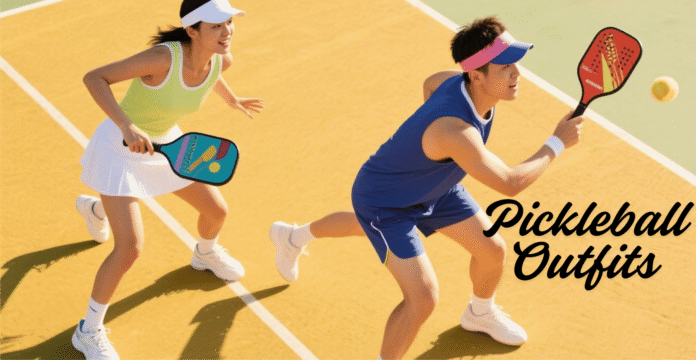
A functional pickleball outfit is three things: a moisture-wicking polyester or polyester-spandex top, bottoms with a pocket that actually holds a 75 mm ball, and court shoes built for lateral movement. Everything else is preference. The single most common mistake is wearing running shoes, and it is also the one most likely to injure you.
Pickleball is played on a 20 by 44 foot court with a seven-foot non-volley zone at each end of the net, which means the game is almost entirely side-to-side movement inside a small box, with sudden stops at the kitchen line. Running shoes are engineered for forward motion on tall, soft midsoles that roll under sideways load. Court shoes are flat, wide and laterally reinforced. That difference matters more than any fabric, color or brand decision you will make.
Below, you will find what to wear, sample outfits for women and men, a fit test to run before you buy, what the materials actually do, which shoes are worth the money and what they cost per hour of play, how to dress for temperature, what tournament dress codes require, how to pack for an all-day event, and three complete outfits at different budgets.
The Three-Piece Foundation
| Piece | What to look for | What to avoid |
|---|---|---|
| Top | Polyester or poly-spandex, 120-160 GSM, raglan or set-in sleeve with full shoulder rotation | Cotton, tight underarms, anything matching the ball color |
| Bottoms | Shorts, skort or leggings with a pocket that fits a 75 mm ball, 5-9 inch inseam | Loose basketball shorts, denim, pockets too shallow to hold a ball |
| Shoes | Court shoes with a lateral TPU cage, flat wide outsole, herringbone or gum rubber tread | Running shoes, cross-trainers, anything with a stack height over 30 mm |
Pickleball Outfit Ideas for Women and Men
The three-piece foundation covers function. Within it there is plenty of room for personal style, and most players settle into one of a handful of combinations that suit their game and the conditions they usually play in.
Women’s pickleball outfit ideas
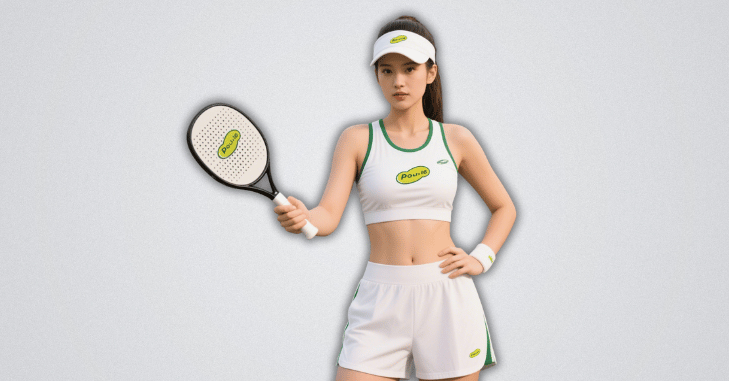
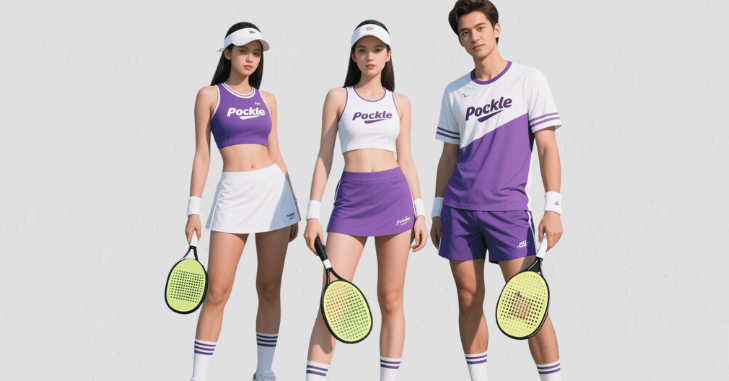
- Classic court look: a fitted polo or racerback tank with a pleated or A-line skort that has a ball pocket on each thigh. Works for club play with a dress code and for casual sessions alike.
- Sun-smart outdoor set: a lightweight long-sleeve UPF 50+ top, a mid-length skort or 5 inch lined shorts, and a visor. Good for midday play on uncovered courts.
- Cool-weather combo: a fitted long-sleeve base layer under a short-sleeve tee, high-waisted leggings with a side pocket, and a removable quarter-zip for warm-up.
- Tank dress: a one-piece athletic dress with built-in shorts and pockets. Quick to put on and comfortable in heat, though it must still pass the ball-pocket lunge test.
Men’s pickleball outfit ideas
- Club standard: a performance polo with flat-lock seams, 7 to 9 inch court shorts with deep side pockets, and white or light-soled indoor shoes.
- Hot-day outdoor kit: a light-colored crew-neck performance tee or long-sleeve UPF top, lined shorts, a cap with a 3 inch brim and Z87+ glasses.
- Cold-morning layers: a synthetic base layer, a tee over it, athletic joggers with tapered ankles that cannot catch on a backpedal, and a quarter-zip you can drop at the fence.
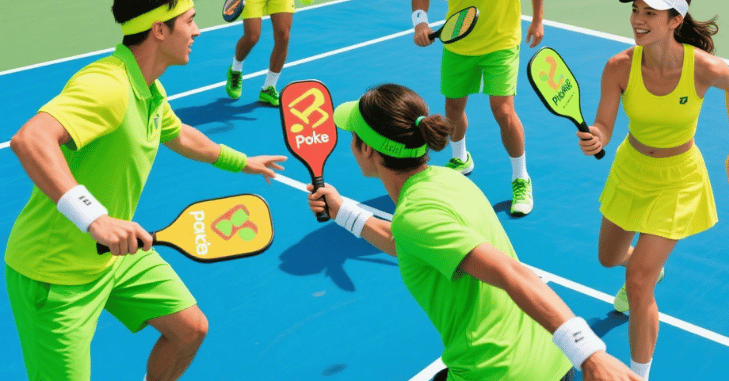
Whatever you choose, keep at least one item in a color that contrasts clearly with the balls your group uses. Bright yellow and neon green are popular apparel colors, but they are also the colors most likely to get you asked to change at a tournament.
Why This Matters More Than It Used To
The sport has outgrown the improvised phase. SFIA’s Topline Participation Report counted 19.8 million Americans playing pickleball in 2024 and 24.3 million in 2025, including 7.48 million core players who turn out eight or more times a year. Core players are the ones whose clothing choices show up as blisters, chafing and sprains, because they are on court weekly rather than twice a summer.
That growth is why every mainstream athletic brand now sells a pickleball-specific line rather than pointing you at the tennis rack, and why pocket dimensions have quietly become a product specification instead of an afterthought. It is also why the injury data is worth reading before you shop.
Fabrics: What Actually Wicks and What Just Feels Nice
The performance difference between fabrics is not marketing. It comes down to moisture regain — how much water a fiber absorbs into itself rather than moving along its surface.
| Fabric | Moisture regain | Verdict for pickleball |
|---|---|---|
| Polyester | About 0.4 percent | Best all-round. Absorbs almost nothing, so sweat travels to the surface and evaporates |
| Nylon | About 4 percent | Good. Softer and more durable than polyester, slightly slower to dry |
| Polyester-spandex (88/12) | About 0.5 percent | Best for skorts, leggings and fitted tops. Spandex supplies four-way stretch |
| Merino wool | Up to 30 percent | Excellent for cold weather and odor resistance, too warm above 70°F |
| Cotton | About 8 percent | Avoid. It absorbs sweat, gets heavy, stays wet and chafes |
| Bamboo viscose | About 11 percent | Comfortable off court, too slow-drying for a two-hour session |
Two additional specifications are worth checking on the label. GSM (grams per square meter) tells you fabric weight — 120 to 160 GSM is the sweet spot for a playing shirt, light enough to breathe and heavy enough not to go transparent when wet. UPF rating matters for outdoor play: UPF 50+ blocks roughly 98 percent of ultraviolet radiation, and a rated shirt outperforms sunscreen you forget to reapply.
There is a trade-off in polyester that the wicking claims never mention. Polyester is oleophilic, meaning it attracts body oils, and those oils are what odor-causing bacteria feed on. That is why a technical shirt can come out of the wash smelling clean and turn sour within ten minutes of warm-up while a cotton shirt does not. The fix is a washing routine, covered further down, rather than a different fabric.
Tops
For women
Sleeveless tanks, racerback tops and short-sleeve tees all work. The decision that matters is shoulder mobility: pickleball involves overhead serves and high volleys, so test any top by raising both arms fully before buying. A built-in shelf bra is convenient for casual play but rarely offers enough support for competitive sessions, where a separate medium-impact sports bra is the better choice. Collared polos are the standard at clubs with a stated dress code.
For men
Performance tees and polos in polyester or a poly blend. Look for flat-lock or bonded seams at the shoulder and underarm, since standard overlocked seams are the usual source of chafing over a long session. Sleeve length is personal, but a slightly trimmer cut through the body keeps fabric from catching the paddle on tight backhands.
Sleeves and sun
A long-sleeve UPF top is worth considering even in heat. A lightweight 130 GSM long sleeve is barely warmer than a tee in moving air, and it removes the forearm and shoulder from the sunscreen routine entirely. Outdoor players are typically on court for 90 minutes to three hours with no shade, often in the middle of the day, which is a larger cumulative exposure than most people give it credit for. Detachable sun sleeves are the cheaper version of the same idea and can be pulled off between games.
Bottoms: The 75 Millimeter Pocket Test
A regulation pickleball measures between 2.87 and 2.97 inches (roughly 73 to 75 mm) in diameter and weighs between 0.78 and 0.935 ounces (22.1 to 26.5 grams), with 26 to 40 evenly spaced holes. The weight is trivial. The diameter is not, and it is why tennis apparel frequently fails pickleball players: the pockets are the wrong depth.
Before buying any shorts, skort or leggings for play, put a ball in the pocket and do a lunge. If it falls out or bulges enough to slap your leg, the garment is not built for this sport.
- Skorts — the most popular women’s option. Built-in compression shorts underneath with a ball pocket on each thigh. Look for a 13 to 15 inch skirt length and a non-roll waistband.
- Athletic shorts with liners — women’s 5 to 7 inch inseam, men’s 7 to 9 inch. Longer than 9 inches restricts the split step.
- Leggings and capris — best below about 55°F. Choose a high, wide waistband and a side pocket rather than a rear one.
- Men’s court shorts — elastic waist with an internal drawcord, two deep side pockets, and enough width in the leg opening for a full lunge.
Indoor and outdoor balls differ, which affects the pocket test. Indoor balls use fewer, larger holes (typically 26) and are lighter and softer; outdoor balls use up to 40 smaller holes and a harder plastic to cut through wind. An outdoor ball is the stiffer, less forgiving object in a pocket, so run the lunge test with one of those rather than the indoor ball from your gym bag.
Underlayers, Liners and Chafe Prevention
The layer nobody sees decides how comfortable the third hour feels. Cotton underwear undoes the benefit of a technical top and shorts because it holds sweat exactly where friction is highest. Choose synthetic briefs, boxer briefs or the built-in liner in your shorts or skort, and make sure the liner’s leg openings sit flat rather than rolling up during lunges.
For women, a separate medium-impact sports bra with wide, flat straps and a moisture-wicking lining is the usual choice for regular play; high-impact styles suit players who move aggressively or prefer more support. For anyone prone to inner-thigh or underarm chafing, a thin anti-chafe balm applied before warm-up is cheaper and more effective than changing an otherwise good outfit.
Shoes: The One Piece Worth Spending Real Money On
Court shoes differ from running shoes in three measurable ways. The stack height is lower, typically 18 to 26 mm versus 30 to 40 mm on a modern running shoe, which reduces the leverage that rolls an ankle. The outsole is wider than the upper at the forefoot, giving a stable platform on hard cuts. And a TPU lateral cage wraps the midfoot to stop the foot sliding off the footbed sideways.
| Model | Approximate US price | Best for | Notes |
|---|---|---|---|
| K-Swiss Express Light Pickleball | $110 to $130 | Outdoor courts | Purpose-built for pickleball, durable outsole compound |
| ASICS Gel-Renma | $90 to $110 | All-court | Strong forefoot cushioning, widely available |
| Skechers Viper Court Pro | $100 to $120 | Comfort-first players | Roomy toe box, popular with senior players |
| FILA Volley Zone | $70 to $90 | Budget outdoor | Good value, heavier than premium options |
| New Balance FuelCell 996 | $130 to $150 | Fast, aggressive players | Responsive but firmer underfoot |
| Babolat Jet Mach 3 | $140 to $160 | Competitive play | Lightweight, snug fit, less forgiving for wide feet |
Indoor versus outdoor soles
Indoor courts need non-marking gum rubber, which grips polished wood or sport tile without leaving streaks. Most facilities will turn you away without it. Outdoor courts are concrete or asphalt, which abrade soft rubber quickly — outdoor shoes use a harder compound and a deeper herringbone tread. Several manufacturers offer a six-month outsole durability guarantee on their outdoor models, which is a genuine indicator of build quality rather than a marketing line.
Expect to replace court shoes every 60 to 90 hours of play if you play primarily outdoors, and every 100 to 150 hours indoors. Worn tread is a slipping hazard long before the shoe looks finished.
The cost per hour that actually decides this
Court shoes look expensive until you price them by the hour, which is the only figure that matters if you play weekly.
| Shoe | Price | Outdoor life | Cost per hour of play |
|---|---|---|---|
| Budget outdoor model | $80 | 60 hours | About $1.33 |
| Mid-range all-court | $100 | 75 hours | About $1.33 |
| Purpose-built pickleball | $125 | 90 hours | About $1.39 |
| Premium competitive | $150 | 90 hours | About $1.67 |
| Running shoes on a court | $140 | Unsafe from hour one | Not applicable |
The spread between the cheapest and the most expensive option is about 34 cents an hour, which is roughly a dollar a session. Fit, width and the presence of a real lateral cage should drive this decision, not price. A player on court twice a week for two hours gets through a pair in four to six months outdoors, so budget for two pairs a year if you play seriously outside.
Dressing Around the Injury Data
Clothing choices in this sport are a safety decision more than a style one, and the epidemiology is unusually clear about who gets hurt and how.
Analyses of US emergency department data found pickleball-related fractures rose roughly 90-fold between 2002 and 2022, with the burden falling heavily on players aged 60 to 69. The dominant mechanism is a fall, most often backpedaling for an overhead or stopping hard at the kitchen line. Shoulder, elbow and wrist complaints make up much of the non-fracture load.
Three clothing conclusions follow directly from that.
- Tread depth is a fall risk, not a cosmetic issue. A smoothed herringbone pattern loses grip on dusty outdoor concrete well before the upper wears out. Check the tread, not the logo.
- Hem length matters on the backpedal. Loose, long bottoms and untied laces are trip hazards specifically during the movement that causes most falls. Leg openings should clear the knee in a lunge without flapping.
- Eye protection is not optional at the kitchen. Volleys are exchanged at two to three meters. Look for lenses marked ANSI Z87+ rather than plain Z87.1 — the plus sign is the high-impact designation, and it is the marking that separates real protective eyewear from a safety-styled sunglass.
Socks and Blister Prevention
Blisters are caused by heat, moisture and friction acting together, and pickleball supplies all three: repeated stops at the kitchen line drive the foot forward and sideways inside the shoe hundreds of times per session. Socks are the cheapest way to break that cycle.
- Material: polyester, nylon or merino blends that move sweat away from the skin. Avoid cotton entirely.
- Height: crew or quarter length keeps the collar of the shoe from rubbing the ankle bone. No-show socks tend to slip down under the heel during lateral movement.
- Cushioning: targeted padding at the heel and ball of the foot, with a thinner section over the top of the foot to avoid overheating.
- Fit with shoes: try shoes on with the socks you will wear. Switching from thin to thick socks can turn a well-fitted shoe into a tight one.
- Hot spots: if you feel a warm, rubbing patch mid-session, stop and deal with it. A strip of blister tape applied early saves a week off court.
Accessories That Earn Their Place
- Eye protection. Polycarbonate lenses rated ANSI Z87+ with an anti-fog coating. Ordinary sunglasses shatter, and a lens that fogs in the third game gets taken off and left off.
- Socks. Crew or quarter-length synthetic blends with targeted cushioning at the heel and forefoot. Never cotton — cotton socks plus sweat equals blisters within an hour.
- Hat or visor. A 3 inch brim covers the eyes on overheads without blocking the ball at the top of your vision. Visors run cooler; caps offer scalp protection.
- Wristbands. Genuinely functional, not decorative. Sweat running down the forearm onto the grip is a leading cause of paddle slip.
- Compression socks. A 15 to 20 mmHg graduated compression is the standard range for athletic recovery and reduced calf fatigue during long tournament days.
- Overgrip and a towel. Not apparel, but a sweat towel clipped to the fence changes how long your grip stays usable. Tacky overgrips suit dry conditions, perforated or cushioned ones suit humid days; most heavy sweaters change them every three or four sessions.
Headwear and Hair: Keeping Sweat and Sun Out of Your Eyes
Sweat running into the eyes and hair blowing across the face are small problems that cost points. On outdoor courts, a cap or visor with a brim of around 3 inches shades the eyes when you look up for a lob without cutting off the ball at the top of your vision. Visors leave the top of the head open and run cooler in heat; caps protect the scalp and part line from sunburn, which matters on long midday sessions.
Players with longer hair usually do best with a low ponytail or braid that sits below a cap’s back strap, plus a moisture-wicking headband to catch sweat at the hairline. Avoid elastic bands with metal clasps, which can loosen during play. Indoors, a headband alone is usually enough, and it keeps sweat off eyewear lenses that would otherwise fog or streak. If you wear prescription glasses, ask your optician about sport frames with impact-rated lenses rather than playing in everyday frames.
Dressing for Temperature
| Conditions | What to wear |
|---|---|
| Above 85°F | Lightest GSM sleeveless or short-sleeve, light colors, UPF 50+, visor, extra shirt for mid-session change |
| 65 to 85°F | Standard performance tee or polo, shorts or skort, cap |
| 50 to 65°F | Long-sleeve base layer under a tee, leggings or joggers, removable quarter-zip for warm-up |
| 35 to 50°F | Merino or synthetic base layer, mid-layer quarter-zip, wind-resistant shell, thermal leggings, light gloves for warm-up only |
| Below 35°F | Move indoors. Cold paddles crack, balls become brittle and lose bounce, and muscle strain risk rises sharply |
The layering principle is simple: dress so you feel slightly cold during the first two minutes of warm-up. If you are comfortable standing still, you will overheat within ten minutes of play.
Humidity changes the calculation more than temperature does. Evaporation is what cools you, and above roughly 70 percent relative humidity sweat stops evaporating efficiently no matter what the shirt is made of. On those days the answer is a change of shirt between games rather than a better fabric, plus lighter colors and a longer break at the fence.
Indoor and Outdoor Kit Are Not the Same Kit
| Element | Indoor | Outdoor |
|---|---|---|
| Outsole | Non-marking gum rubber, shallow tread | Harder compound, deep herringbone |
| Shoe life | 100 to 150 hours | 60 to 90 hours |
| Ball | Lighter, 26 larger holes, softer plastic | Harder, up to 40 smaller holes |
| Sun protection | Not needed | UPF 50+ top, brim, protective lenses |
| Layering | Stable climate, one layer | Removable quarter-zip for warm-up |
| Grip | Standard overgrip lasts longer | Change more often; wind and dust accelerate wear |
If you play both, keep two pairs of shoes and never take the outdoor pair indoors. Grit embedded in an outdoor outsole marks a wood floor and will get you asked to leave.
Choosing Colors With Visibility in Mind
Color matters for more than style. Light colors reflect sunlight and run noticeably cooler on outdoor courts, while dark colors absorb heat and show salt marks from dried sweat. White and pale pastels are the traditional club choice for that reason.
Visibility cuts both ways. Clothing that blends into the ball makes it harder for opponents to track the ball off your paddle, which is why tournaments can require a change. Clothing that blends into the court or background makes you harder for your partner to read in doubles. A simple rule works for most players: choose a top that contrasts with both the ball your group uses and the court surface, and save neon yellow, lime and bright orange for days when you know the balls are a different color.
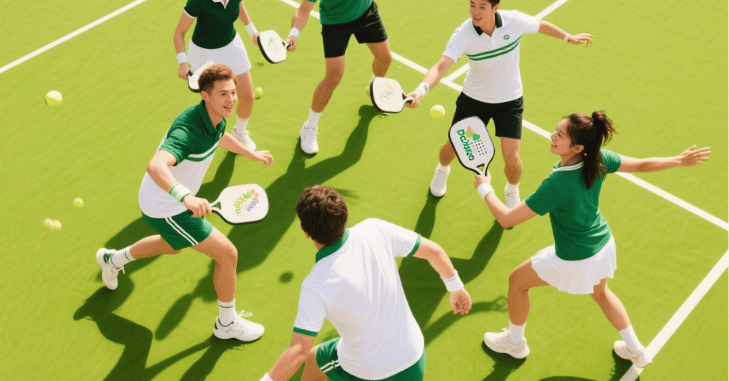
For teams and doubles partners, coordinating colors is a popular touch at local events. It also helps spectators and officials tell teams apart on a crowded multi-court site.
Tournament Dress Codes and the Ball Color Rule
Recreational play has essentially no rules. Sanctioned tournaments do, and the one that catches people out is about visibility rather than modesty.
Pickleballs are typically yellow, neon green or orange. Under the USA Pickleball rulebook, tournament officials can require a player to change clothing that closely matches the ball color, because it makes the ball hard for the opponent to track. If you own one neon yellow shirt, it is the one to leave at home on tournament day. The rulebook is revised annually, so check the current edition rather than relying on what a partner told you two seasons ago.
Beyond that, most sanctioned events require players to wear a shirt at all times, permit shorts, skorts, leggings and athletic pants, and prohibit clothing with offensive graphics. Private clubs frequently layer their own dress code on top — collared shirts are the most common requirement, and some facilities ban dark-soled shoes on indoor courts entirely. Check before you drive there.
Packing for a full tournament day
Sanctioned events run brackets across six to ten hours, with long gaps between matches. Packing for one is a different exercise from packing for a social session.
| Item | Quantity | Why |
|---|---|---|
| Performance shirts | 3 | One per bracket block; a wet shirt in a cold breeze between matches is how people stiffen up |
| Socks | 3 pairs | Dry socks are the cheapest blister prevention available |
| Bottoms | 2 | One spare, tested for the ball pocket |
| Court shoes | 1 broken-in pair | Never a new pair on the day |
| Compression socks | 1 pair | Worn between matches, not during |
| Quarter-zip or hoodie | 1 | For the hour you spend waiting in shade |
| Overgrips | 2 | Grip degradation is gradual and easy to miss |
| Towel and spare eyewear cloth | 1 each | Fogged or salt-streaked lenses end up in the bag |
Three Complete Outfits by Budget
| Tier | Top | Bottom | Shoes | Approximate total |
|---|---|---|---|---|
| Starter | Generic polyester performance tee, $18 | Basic lined athletic shorts, $25 | FILA Volley Zone, $80 | About $125 |
| Regular player | Brand performance polo, $50 | Skort or court short with ball pockets, $55 | ASICS Gel-Renma, $100 | About $205 |
| Competitive | Technical UPF 50+ top, $75 | Premium skort or short, $80 | K-Swiss Express Light Pickleball, $125 | About $280 plus accessories |
If you are building from nothing, the allocation that gives the best return is roughly 60 percent of the budget on shoes and 40 percent on everything else. A $20 shirt and a $120 shoe will serve you far better than the reverse.
What to buy first, in order
- Court shoes. Everything else can be improvised from what is already in your drawer. This cannot.
- Eye protection. Around $25 for a Z87+ pair, and the cheapest insurance in the sport.
- Two pairs of synthetic socks. Cheaper than one blister-shortened week.
- One bottom with a tested ball pocket. This is the item most likely to be wrong in existing gym clothes.
- A second performance top. So one can be in the wash.
That sequence gets a new player properly equipped for roughly $150 to $180, with a clear upgrade path afterward. For off-court footwear once the session is over, our roundup of the best summer shoes is a better guide than reaching for the court pair again.
The Five-Minute Fit Test Before You Buy
Most bad pickleball clothing purchases fail in ways you can spot before you remove the tags. Run this routine at home or in the fitting room, with the shoes and socks you will actually play in:
- Overhead reach: raise both arms fully as if hitting an overhead. The top should not ride up past the waistband or pull tight across the shoulders.
- Ball-pocket lunge: put an outdoor ball in each pocket and do three deep lunges to each side. Nothing should fall out or slap against your leg.
- Split step: do a few quick hops and side shuffles. Waistbands should stay put without constant adjusting, and skorts should not twist.
- Heel lock: lace the shoes fully and rise onto your toes. Your heel should not lift noticeably out of the shoe.
- Toe room: leave roughly a thumb’s width between your longest toe and the end of the shoe, measured late in the day when feet are largest.
- Lateral stop: plant hard to one side on a non-slippery floor. The foot should stay on the footbed instead of sliding over the edge of the sole.
If an item fails any step, return it while it is still unworn. A garment that is mildly annoying for five minutes will be a real distraction over a two-hour session.
Building a Rotation: How Much Kit You Actually Need
Performance fabrics dry quickly, but they still need washing after every session to stay fresh and keep wicking. How many sets you need depends on how often you play.
| Sessions per week | Tops | Bottoms | Socks | Court shoes |
|---|---|---|---|---|
| 1 | 2 | 1 to 2 | 2 to 3 pairs | 1 pair |
| 2 to 3 | 3 to 4 | 2 | 4 pairs | 1 pair, replaced about every 4 to 6 months outdoors |
| 4 or more | 5 or more | 3 | 6 pairs | 2 pairs rotated, so foam can recover between sessions |
Rotating two pairs of shoes is worth considering for frequent players. Midsole foam compresses during play and benefits from time to dry out and rebound, and having two pairs also makes it obvious when one has worn significantly faster than the other.
Fit Notes for Bigger, Taller and Adaptive Players
Pickleball draws players of every age and build, and standard athletic sizing does not always keep up. Bigger and taller players should look for tall sizes in tops so the hem stays tucked on overheads, gusseted crotches in shorts for a full lunge, and wide or extra-wide court shoes rather than sizing up in length, which weakens lateral support. Players with joint concerns often prefer longer shorts or capris for warmth around the knees and shoes with extra forefoot cushioning. Anyone using a knee brace or ankle support should try on bottoms and shoes while wearing it, since a brace can change how a hem sits and how a shoe fits.
Six Mistakes Worth Avoiding
- Running shoes. Repeated because it is the big one. High, soft midsoles roll under lateral load.
- Cotton anything. Shirt, socks, underwear. It holds sweat, adds weight and causes chafing.
- Pockets that do not hold a ball. Test with an actual outdoor ball, not a guess.
- Fabric softener and dryer sheets. They coat synthetic fibers with a waxy residue that destroys wicking permanently.
- No eye protection. Close-quarters volleys at the kitchen line travel fast enough to cause real damage.
- Brand-new shoes on tournament day. Court shoes need three or four sessions to break in around the lateral cage.
Caring for Performance Fabrics
Synthetic athletic fabrics fail in a specific way: they stop wicking and start smelling. Both problems have the same cause, which is residue trapped in the fiber.
- Wash in cold water, inside out, on a gentle cycle. Keep it under 104°F (40°C), since heat degrades elastane and sets oils into polyester.
- Use half the normal detergent. Excess detergent is itself a residue that traps bacteria.
- Never use fabric softener or dryer sheets. They are the single fastest way to ruin a technical shirt.
- For persistent odor, soak for 30 minutes in one part white vinegar to four parts cold water before washing. An enzyme-based sports detergent targets the body oils that ordinary detergent leaves behind.
- Do not leave kit balled up in the bag. Bacteria multiply fastest in a warm, damp, sealed space, and an overnight gym bag does more odor damage than the session itself.
- Hang dry or tumble on low. Synthetics dry in under an hour anyway.
- Air shoes out between sessions, remove the insoles to dry, and never leave them in a hot car, which breaks down midsole foam.
Where to Shop
Specialist retailers such as Pickleball Central, Total Pickleball and Tennis Warehouse carry the widest range of court-specific footwear and apparel with proper sizing information. Mainstream athletic brands including Nike, Adidas, FILA, K-Swiss and Skechers all now run dedicated pickleball lines, a direct response to the participation numbers above. Department and sporting goods stores are useful mainly for trying shoes on before ordering online.
Two buying habits save money. Shoe models are refreshed roughly annually, so the outgoing version of a good court shoe frequently sells at 30 to 40 percent off with no meaningful change in construction. And apparel sizing across pickleball-specific brands runs noticeably smaller than mainstream athletic sizing, so check the measurement chart rather than the letter on the label.
For everyday style outside the court, see our guide to the denim on denim outfit, and for the club social afterwards, the winter cocktail dress guide covers a very different dress code. If sizing is your main obstacle, our tips on how to dress confidently in big men’s clothes apply just as well to athletic wear.
Outfit Notes by Player Type
| Player | Priority | Specific advice |
|---|---|---|
| Complete beginner | Not getting hurt | Buy the shoes first and play in whatever athletic clothes you own. Upgrade apparel after ten sessions |
| Weekly social player | Comfort over three hours | Two performance tops in rotation, one bottom with tested pockets, one pair of court shoes |
| Club and league player | Meeting the dress code | Collared polos, indoor gum-sole shoes kept separate from outdoor pairs |
| Tournament competitor | All-day durability | Three shirts for a single day, spare socks, compression socks between matches, no ball-colored clothing |
| Player over 60 | Stability and joint load | Wider toe box, extra forefoot cushioning, longer bottoms for sun and knee warmth, and the strictest attitude to worn tread of anyone on court |
| Junior player | Growth and cost | Adjustable waistbands, avoid buying a size up in shoes as it defeats the lateral support |
Frequently Asked Questions
Can I wear running shoes for pickleball?
You should not. Running shoes have tall, soft midsoles built for straight-line forward motion, and they roll under the hard lateral cuts pickleball demands, which is a common cause of ankle sprains. Court shoes sit lower, have a wider outsole at the forefoot, and use a TPU cage to keep the foot on the footbed during sideways movement.
What is the difference between tennis and pickleball clothing?
Functionally they are close, and most tennis apparel works. The main difference is pocket depth: a regulation pickleball is 2.87 to 2.97 inches (roughly 73 to 75 mm) in diameter, larger than a tennis ball, so many tennis skorts and shorts have pockets too shallow to hold one securely during a lunge. Test with an actual outdoor ball before buying.
Is there a dress code for pickleball?
Recreational play has essentially none. Sanctioned tournaments typically require a shirt at all times, prohibit offensive graphics, and allow officials to make a player change clothing that closely matches the ball color. Private clubs often add their own rules, most commonly collared shirts and non-marking soles on indoor courts.
What should women wear to play pickleball?
A moisture-wicking tank, tee or polo, a skort or lined athletic shorts with ball pockets, and court shoes. A skort with built-in compression shorts and a pocket on each thigh is the most popular setup. For competitive play, a separate medium-impact sports bra usually beats a built-in shelf bra.
What fabric is best for pickleball clothing?
Polyester or a polyester-spandex blend around 88/12. Polyester barely absorbs water, so sweat moves to the fabric surface and evaporates, while cotton soaks it up, gets heavy and stays wet. For outdoor play, look for 120 to 160 GSM fabric with a UPF 50+ rating.
How often should I replace pickleball shoes?
Roughly every 60 to 90 hours of play on outdoor concrete or asphalt and every 100 to 150 hours indoors. Judge by tread depth and lateral support rather than appearance, because a shoe with smoothed herringbone tread becomes a slipping hazard long before the upper looks worn.
Bottom Line: Building Your Pickleball Outfit
Start with court shoes that fit your feet and the surface you play on, add Z87+ eye protection and synthetic socks, then build the rest around wicking polyester tops and bottoms that genuinely hold a ball. Run the fit test before you keep anything, wash technical fabrics cold without softener, and replace shoes by the hour rather than by the look. Get those basics right and the colors, cuts and brands are simply a matter of taste.