
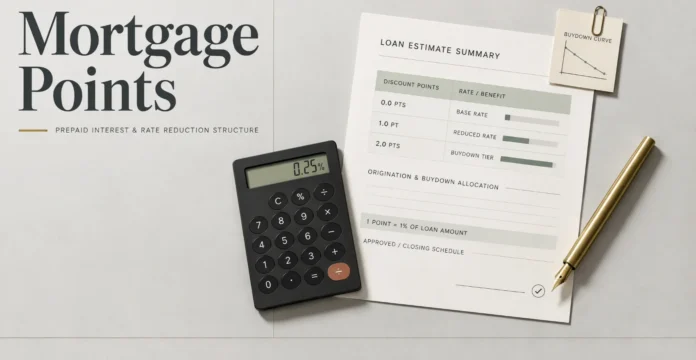
Mortgage points let you pay more at closing in exchange for a lower mortgage interest rate. One point costs 1% of your loan amount, although the rate reduction varies. Whether paying points saves money depends mainly on how long you keep the loan.
For a $400,000 mortgage, one point costs $4,000. That upfront expense can reduce your monthly principal and interest payment. The decision becomes worthwhile only after your accumulated savings exceed the initial cost.
Direct answer: A mortgage point generally costs 1% of the loan amount and buys a lower interest rate. The exact rate reduction depends on your lender, loan type, and market conditions. Paying points usually makes the most sense when you expect to keep the mortgage beyond its calculated break-even date.
| Key question | General U.S. answer |
|---|---|
| What does one point cost? | 1% of the mortgage amount |
| Does one point always cut the rate by 0.25%? | No. Pricing varies by lender and market conditions |
| When are points paid? | Usually at closing |
| What is the main benefit? | A lower interest rate and monthly payment |
| What determines whether they are worthwhile? | Your break-even period and expected loan duration |
| Can points affect taxes? | Potentially, subject to IRS deduction rules |
| Are points mandatory? | Discount points are generally optional |
What Are Mortgage Points?

Mortgage points are upfront fees paid to a lender for a lower interest rate. They are commonly called discount points or an interest-rate buydown. The fee becomes part of the cash you need for closing.
One point equals 1% of the amount borrowed. A point on a $250,000 loan therefore costs $2,500. A half-point on the same mortgage would cost $1,250.
The percentage cost is standardized, but the interest-rate reduction is not. Your lender determines the available pricing when you lock your loan. Market conditions, loan type, and borrower characteristics can all affect the offer.
How Much Can One Point Lower Your Mortgage Rate?
You may hear that one point lowers a rate by 0.25 percentage points. That figure can work as an illustration, but it is not guaranteed. The Consumer Financial Protection Bureau says the rate reduction depends on the lender, loan type, and market.
Suppose a lender offers a $400,000 mortgage at 6.75% without points. The same lender might offer 6.50% after charging one point. In that example, you would pay $4,000 upfront for the lower rate.
Another lender could quote a different reduction for the same cost. This is why borrowers should compare actual Loan Estimates instead of relying on a rule of thumb. Ask each lender to quote comparable options with zero points and with points.
How the Break-Even Point Works
The break-even calculation shows how long your monthly savings need to recover the upfront fee. Divide the amount paid for points by the monthly payment savings. The result is your approximate break-even period in months.
For example, assume one point costs $4,000 and reduces your payment by $65 monthly. Dividing $4,000 by $65 produces about 62 months. You would need roughly five years and two months to recover the cost.
That calculation gives you a practical decision line. Keeping the mortgage longer may produce net savings after the break-even date. Selling or refinancing earlier could leave you with an unrecovered upfront expense.
Break-Even Example
| Item | Zero-point loan | Loan with one point |
|---|---|---|
| Mortgage amount | $400,000 | $400,000 |
| Upfront point cost | $0 | $4,000 |
| Example rate | 6.75% | 6.50% |
| Example monthly savings | $0 | About $65 |
| Approximate break-even | N/A | About 62 months |
The numbers above are an illustration rather than a lender quote. Actual payment savings depend on your rate difference and loan terms. Always calculate the break-even period from the offers you receive.
When Paying Points May Make Sense
Buying a lower rate becomes more attractive when you expect to keep the mortgage for many years. A longer holding period gives monthly savings more time to exceed the upfront charge. Stable homeowners may therefore benefit more than short-term owners.
Points may also suit borrowers who have enough cash after closing. Draining emergency savings to obtain a slightly lower rate can create another financial problem. You should preserve enough cash for moving costs, repairs, and unexpected expenses.
The comparison should include realistic plans rather than a thirty-year assumption. You might move because of work, family needs, or changing housing requirements. You might also refinance if future rates make another loan attractive.
Consider paying points when:
- You expect to keep the mortgage well beyond the break-even period.
- The lender offers a meaningful rate reduction for the fee.
- You can afford the additional closing cost without exhausting savings.
- Lowering the required monthly payment fits your financial plan.
- You have compared several lenders using equivalent point structures.
NewPape readers evaluating property as a longer-term asset may also find its discussion of luxury-home resale value useful. Resale expectations can influence how long you realistically expect to own a property.
When Paying Points May Not Be Worth It
Points are less appealing when you expect to sell before reaching break-even. They can also be risky when refinancing within a few years appears likely. In either case, you may surrender the remaining value of the upfront fee.
Cash availability matters as much as the interest calculation. A home purchase often brings repairs, furnishings, insurance costs, taxes, and moving expenses. Keeping several thousand dollars liquid may provide more value than a modest payment reduction.
You should also compare points with other uses for the same money. A larger down payment may reduce the amount borrowed. Paying down higher-interest debt can sometimes offer a clearer financial benefit.
Discount Points Versus Origination Points
The word “points” can describe different mortgage charges, so the distinction matters. Discount points reduce your interest rate in exchange for an upfront payment. Origination charges compensate a lender for making or processing the loan.
Do not assume every percentage-based lender fee buys a lower rate. Ask your lender which charges directly affect the interest rate. The CFPB also recommends confirming the effect of any points shown on your loan documents.
Your Loan Estimate provides an important place to check. Points tied to a discounted interest rate appear among the loan costs. Compare that document carefully when evaluating competing mortgage offers.
Mortgage Points Versus Lender Credits
Lender credits generally work in the opposite direction from discount points. You accept a higher interest rate in exchange for help with closing costs. That arrangement reduces upfront cash but usually increases borrowing costs over time.
Neither choice is automatically better. A borrower short on closing cash may value lender credits more than a lower rate. A long-term homeowner with strong reserves may prefer paying upfront for lower ongoing costs.
The CFPB recommends comparing several timelines when deciding between these structures. Consider a short holding period, a likely period, and a longer period. That approach can show which option fits your actual plans.
Are Mortgage Points Tax-Deductible?
Certain points may qualify as deductible mortgage interest under U.S. federal tax rules. The answer depends on the loan purpose, property, payment structure, and other requirements. You generally need to itemize deductions to benefit.
IRS Publication 936 explains that some qualifying purchase-loan points can be deducted during the year paid. Other points may need to be deducted gradually over the mortgage term. Refinancing points usually follow different timing rules.
Tax treatment can change with individual circumstances and future legislation. Keep your Closing Disclosure and Form 1098 with your tax records. Consult current IRS instructions or a qualified tax professional before claiming a deduction.
How to Compare Loan Offers With Points
Start by requesting comparable Loan Estimates from several lenders. The CFPB recommends shopping among multiple lenders because pricing structures differ. Comparing identical point levels makes the offers easier to judge.
Do not choose an offer because the advertised interest rate looks lowest. A low displayed rate may require substantial upfront fees. Compare both immediate cash requirements and longer-term costs.
You can also think about how the loan fits your wider property finances. NewPape’s explanation of equity in real estate and collateral provides useful background on property value minus outstanding debt. Homeowners dealing with shared ownership may also benefit from its discussion of property taxes, liens, and mortgages in partition cases.
A Simple Decision Framework
First, ask the lender for both a zero-point quote and one or more discounted-rate quotes. Record the dollar cost and monthly savings for each version. Avoid comparing quotes prepared on different days when rates have changed materially.
Next, calculate the break-even period for every point option. Compare that result with how long you realistically expect to keep the mortgage. Use the loan duration rather than simply asking how long you will own the house.
Finally, consider what the upfront money could do elsewhere. Cash reserves, debt reduction, or a larger down payment can compete with points for the same dollars. The best choice depends on the alternative producing the most useful financial benefit.
The Bottom Line
Paying points is essentially a trade between money now and potential savings later. The decision works best when the upfront cost buys meaningful savings across a long holding period. Your break-even calculation should guide the choice rather than a generic rate-reduction assumption.
Ask lenders for comparable quotes with and without points before choosing a loan. Calculate the break-even date for every offer and test it against your likely plans. Keep enough savings available after closing for the costs homeownership can bring.
For U.S. borrowers, the strongest decision comes from comparing real Loan Estimates rather than advertised rates. The lowest interest rate does not always produce the lowest total cost. Choose the structure that fits your expected loan duration, available cash, and financial priorities.
Frequently Asked Questions
Are mortgage points worth paying?
Mortgage points can be worthwhile when you keep the loan beyond the break-even date. They become less attractive when you expect to move or refinance sooner. Compare the actual upfront cost with projected monthly savings before deciding.
How much does one point cost on a $300,000 mortgage?
One point on a $300,000 mortgage costs $3,000. That follows the standard calculation of 1% of the loan amount. The interest-rate reduction you receive for that $3,000 is lender-specific.
Does one point always lower the interest rate by 0.25%?
No. Some examples use a quarter percentage point because it makes the math easy to understand. The actual reduction varies with lender pricing, loan products, and market conditions.
Can you buy half a point?
Yes, lenders can offer fractional points. Half a point equals 0.5% of the mortgage amount. On a $400,000 loan, half a point would cost $2,000.
What happens to points if you refinance?
Refinancing ends the original loan, so future payment savings from that rate also end. Refinancing before break-even can make the original point purchase financially disappointing. Tax treatment for remaining deductible amounts follows separate IRS rules.
Where can you find points on your loan documents?
Your lender should disclose qualifying discount points on the Loan Estimate and Closing Disclosure. Review the listed costs and ask which fees directly reduce your rate. Never assume every charge labeled as a point provides a rate discount.