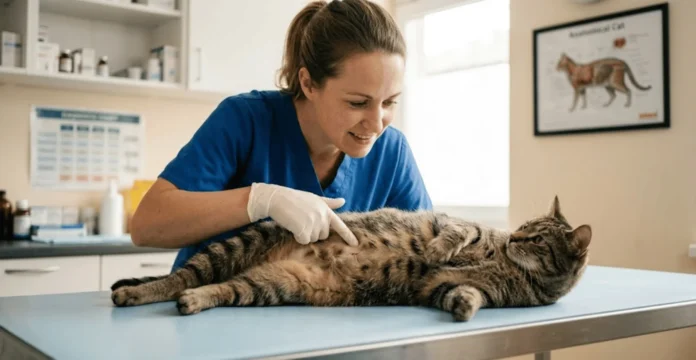
Do cats have belly buttons? Yes, most cats have a small navel scar where the umbilical cord attached before birth. You usually cannot see it because the mark is flat, tiny, and hidden by fur. It’s easier to find once you know the location and what normal tissue looks like.
Direct answer: Yes. A cat’s belly button is a small scar on the midline of the abdomen, usually just below the rib cage. It forms after the umbilical cord detaches following birth. Unlike a human navel, it is usually flat, faint, and hidden beneath fur rather than shaped like an innie or outie.
| Question | Quick answer |
|---|---|
| Does every cat have one? | Typical cats do because they develop with an umbilical cord before birth. |
| Where is it? | On the belly’s midline, usually just below the rib cage. |
| What does it look like? | A tiny, flat scar or faint hairless spot. |
| Is a bump normal? | A noticeable bulge may be an umbilical hernia and deserves veterinary evaluation. |
| Can fur hide it? | Yes. Long or dense coats can make the scar almost impossible to see. |
Key Takeaways
- The feline navel is a healed umbilical-cord attachment site.
- It usually sits just below the ribs along the center of the abdomen.
- Most look like flat scars, not human-style innie or outie scars.
- A soft or firm bulge can be a hernia rather than a normal scar.
- Stop searching if your cat resists belly handling or becomes stressed.
Why Cats Have a Navel Scar
Cats develop a navel for the same basic reason other placental mammals do. Before birth, the umbilical cord connects each kitten to its placenta. That connection supports the kitten while it develops inside the uterus. After delivery, the remaining attachment heals into the small scar called the umbilicus.
Mother cats usually chew through each kitten’s cord shortly after birth. The small remaining stump then dries and falls away as the area heals. PetMD describes the adult mark as the scar left after that cord detaches. Cats.com gives the same basic explanation in its veterinarian-written anatomy guide.
Do Cats Have Belly Buttons, and Where Are They Located?
The navel sits on the underside, along the abdomen’s center line, just below the lower ribs. VCA Animal Hospitals places the feline umbilicus just below the rib cage. Thick fur can hide the mark completely, especially in longhaired cats. Hairless cats or recently shaved cats make the spot easier to inspect.
The scar does not sit in a row with the nipples, which appear in paired lines. It also should not look like the loose skin near the rear legs. A recent spay scar can create confusion because it may cross the abdomen’s midline. The navel is usually much smaller and more localized than a surgical incision.
What Does a Cat Belly Button Look Like?
A normal feline navel is usually subtle enough to miss during routine grooming. It may look like a tiny flat scar, faint wrinkle, or small hairless patch. Some cats have a slight change in hair direction around the spot, which is easiest to see on the short coats described in NewPape’s orange tabby cat guide. A prominent round bulge is not typical.
| What you notice | What it may be | What to do |
|---|---|---|
| Small flat scar on the midline | Normal umbilicus | No action is usually needed |
| Small bumps in two rows | Nipples | Normal anatomy in male and female cats |
| Longer line or healing incision | Possible spay scar | Check surgical records if you are unsure |
| Soft or firm rounded bulge | Possible umbilical hernia | Arrange a veterinary examination |
| Loose flap near the rear legs | Primordial pouch | Normal body feature in many cats |
This comparison can help you avoid confusing several ordinary body features. A spay scar may be longer, while the primordial pouch sits farther toward the hind legs. A hernia differs because tissue protrudes through an opening near the umbilical area. VCA recommends veterinary assessment when an umbilical bulge is present.
How to Find Your Cat’s Navel Safely
Choose a time when your cat is relaxed and already comfortable with gentle handling. Let the cat stay in a natural position instead of forcing it onto its back. Part the fur below the rib cage and look along the center line. Stop immediately if the cat stiffens, swats, growls, or tries to leave.
- Start below the lowest ribs, not near the hind legs.
- Use your fingers or a soft comb to gently part the fur.
- Look for a tiny flat scar rather than a deep indentation.
- Avoid squeezing any lump or trying to push a bulge inward.
Many cats dislike having their abdomen touched because it is a vulnerable area. A missing visual mark does not mean the scar is absent. Dense fur and smooth healing can make the site nearly invisible. If you only want reassurance, a routine veterinary visit is a safer place to ask.
Can a Cat Have an “Outie” Navel?
A true human-style outie is not the usual feline pattern. A visible bump around the umbilicus can instead be an umbilical hernia. VCA explains that this happens when the umbilical ring does not fully close after birth. Fat or abdominal tissue can then protrude through the opening.
Many small hernias are painless, and some tiny defects close as kittens grow. VCA notes that small hernias may close spontaneously by about three to four months. A veterinarian may repair persistent defects during spay or neuter surgery. Larger hernias need more careful assessment because abdominal organs can sometimes become trapped.
When Should a Veterinarian Check the Area?
A flat, unchanged scar usually doesn’t need special care. A new lump, painful swelling, or irritated area deserves professional attention. Merck Veterinary Manual notes that hernias can contain fat or, in more serious cases, intestinal loops. The risk depends on what protrudes and whether tissue becomes trapped.
- Seek prompt care for pain, warmth, redness, or rapid swelling.
- Call a veterinarian if the bulge becomes firm or suddenly larger.
- Urgent signs include vomiting, loss of appetite, weakness, or marked discomfort.
- Newborn kittens need prompt care for discharge, bleeding, or inflamed umbilical tissue.
Do not diagnose a lump by appearance alone because several structures can look similar through fur. Avoid pressing hard on the area or testing whether a bulge can be pushed inward. A veterinarian can examine the abdominal wall and decide whether monitoring or treatment is appropriate. That approach is safer than repeated home checks.
What Happens to a Kitten’s Umbilical Cord?
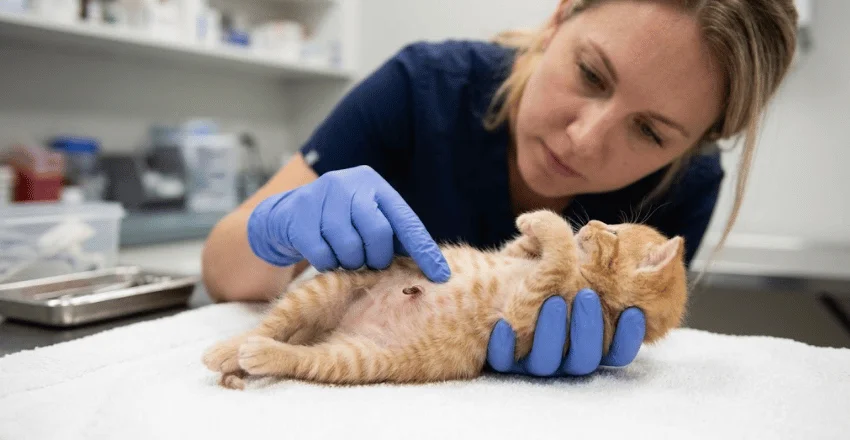
Each kitten develops with its own umbilical connection before birth. After delivery, the mother usually chews through the cord and leaves a short stump. That stump dries, shrivels, and drops off while the attachment site heals. The remaining mark becomes the adult navel.
Do not pull a drying stump from a newborn kitten. Cats.com advises allowing the stump to detach naturally when it is ready. Redness, swelling, pus, or persistent bleeding are not normal signs of healing. A veterinarian should assess those changes quickly because young kittens can become ill fast.
What Else Can Look Like the Navel?
Nipples are the most common source of confusion because both sexes have them. A spay incision can also sit near the midline and may feel more obvious. The primordial pouch hangs farther back and covers a broader area. These differences make location and shape more useful than color alone.
Coat type can change what you see without changing the underlying anatomy. A shorthaired orange cat may reveal skin details that vanish under a thick long coat. That same guide explains how coat traits vary across individual cats. The NewPape Pets section also collects related animal-focused reading.
Frequently Asked Questions
Do cats have belly buttons if you cannot see one?
Yes, the scar can be present even when you cannot find it. Fur, skin color, and smooth healing can hide the mark. You do not need to keep searching if your cat dislikes belly handling. A veterinarian can point out the area during a routine examination.
Do male cats have a navel too?
Yes, male and female kittens both develop with umbilical cords before birth. Sex does not determine whether the scar forms. The location and general appearance are the same for both. Both sexes also have nipples, which can cause confusion.
Why does my cat have a lump near the navel?
A lump may be an umbilical hernia, especially in a kitten. It can contain fat or other tissue passing through an incompletely closed opening. Most lumps need a veterinarian to determine their size and importance. Sudden pain, vomiting, or a firm swelling needs faster attention.
Can a spay scar be mistaken for the navel?
Yes, especially if the surgery used a midline incision. A surgical scar is usually longer than the tiny umbilical mark. Medical records can confirm whether your cat was spayed and where the incision was placed. Your veterinarian can also distinguish the two during an exam.
The Bottom Line
Your cat’s navel is a normal scar from life before birth, not a special organ that needs routine care. Most owners never notice it because the mark is small and hidden by fur. A visible bulge is different and may need veterinary evaluation. Knowing that distinction can prevent unnecessary worry and delayed care.
If feline anatomy interests you, explore NewPape’s Pets coverage and its broader Lifestyle section next. You can also read the site’s orange tabby guide for more cat-focused information. Keep home checks gentle and brief, and bring any new abdominal lump to a veterinarian. That is the most useful next step when appearance alone cannot give a clear answer.